No quick matches. Press enter to see full results.

No quick matches. Press enter to see full results.
When we talk about modern technology and advancements in the workforce, there’s one area of your business operations that may not scream “innovation”: The mailroom.
It’s a mostly behind-the-scenes operation that many organizations are questioning (or may not use anymore with the shift to remote work). However, in certain types of organizations, especially those dealing with billing and large quantities of incoming information, it’s still an essential function. Whether a company employs 50 or 250,000 people, having secure and efficient mailroom operations is of utmost importance as they ensure communications and documents are getting to employees as quickly as possible, helping with everything from customer engagement to billing.
Before COVID-19, many mailrooms already had pain points within their operations, including scalability, compliance, and ROI. Throw a pandemic into the mix, and now those mailrooms are dealing with a new remote workforce and a complete 180 from the mailrooms of the past.
What’s more, it doesn’t look like this new working structure will be changing anytime soon. A
A PwC survey of nearly 700 CEOs revealed that 78% believe remote work is here to stay, meaning many mailrooms straining to keep up with these new operations hurdles need to do something if they want to mitigate stress and bridge their analog-to-digital gap so all processes are running as efficiently as possible.
I know what you may be thinking.
“Why invest in a solution if we may, one day, go back to normal?”
My response typically sounds a bit like, “Do you want to go back to how you were doing things if there’s a better way?” And that’s the truth. There is a better way – a digital mailroom solution that’s built with flexibility, security, and efficiency in mind.
This year, we partnered with Eco-Mail to provide our clients with an innovative digital mailroom solution that many Fortune 500 companies have adopted to keep their businesses moving forward. This platform, especially when paired with the end-to-end suite of services and solutions we offer, created the perfect “future-proofing” solution for businesses and organizations alike.
To put it simply, focusing on bridging that gap will help revolutionize the way you do business by driving greater efficiency, security, and remote collaboration. But let’s get into why it will help.
Ingest and classify all analog communications as they come in.
Depending on the intake process, once analog content is digitized, we can encrypt it in motion and at rest.
Processing time can go from days to mere seconds and with extreme accuracy. For example, if your organization employs six people named Adam Smith, the solution will know exactly which one the mail needs to go to.
Pull important metadata from each piece of mail and import it to your system of record, helping you build a library of accessible, searchable information.
Utilize information-rich data to inform your business decisions and identify areas of opportunity within your current processes.
What kinds of overhead costs could I cut with this sort of digital mailroom solution?
Our digital mailroom solution is the only full-suite solution to digitize mail in the industry. It can help reduce or even completely eliminate costs associated with:
I know, I know. That’s quite a list. That said, it’s a bit easier to explain how our solution can help reduce overhead costs (and boost ROI!) by showing you how it helped one of the top 20 banks in the country.
Learn more about mailroom automation services – the impact could be astronomical.
There’s a lot of data out there. It comes in all sorts of different forms and sizes, and it can be tough to know what to do with it all. Every organization has structured, semi-structured, and unstructured data.
According to the International Data Corporation, about 80% of global data will be unstructured by 2025, but most organizations aren’t tapping into any of that data. What you do with that untouched data matters. That data can now be processed and analyzed to help us make better business decisions and improve customer experience.
Structured data is information that is distinctively organized, factual, and related. It’s data that is easily readable and understandable by humans. Structured content is what we commonly consider data easily put into a spreadsheet, and it has predefined fields like headers with data falling into those categories.
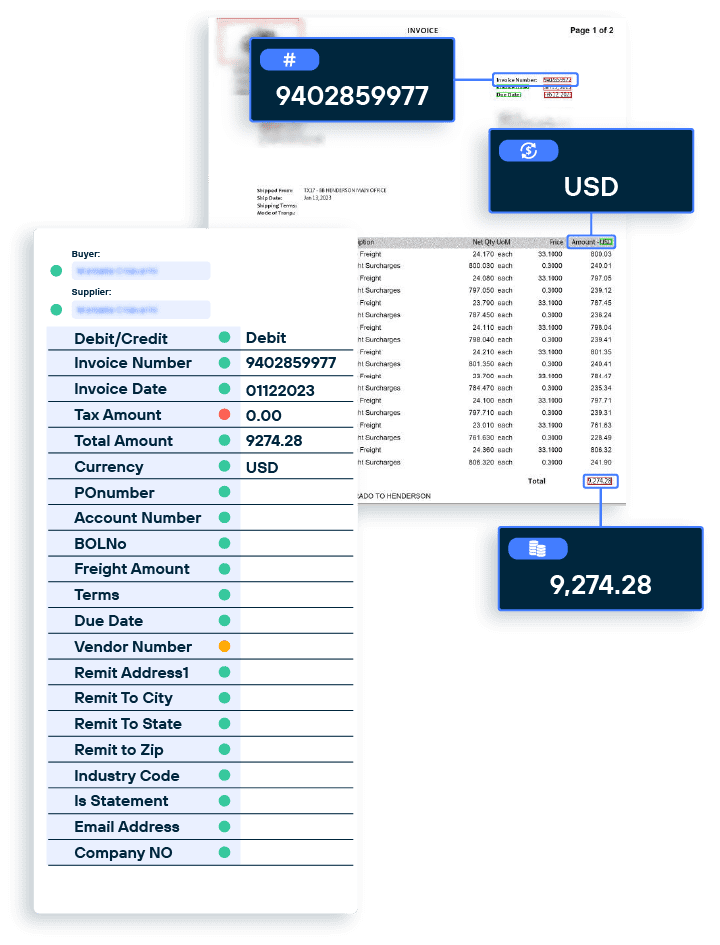
Company A has structured invoices. The headers and data are in the exact location on every invoice they use.
Unstructured data isn’t predefined or organized, but somewhat sporadic and all over the place. Unstructured data does not conform to a data model and does not readily have an identifiable structure that a computer program can use.
It comes in many shapes and sizes, like a paper document with write-in answers, a video, text messages, or even a website. Unstructured data is much more challenging to search and analyze and often includes qualitative data.
It requires more cutting-edge analytics techniques like data mining or text mining. Data mining is detecting patterns and interactions in large data sets to express potential outcomes in advance. In contrast, text mining turns unstructured data into structured data through natural language processing. Recent projections believe that 80% to 90% of the world’s data is unstructured, and only 0.5% is analyzed and used today.
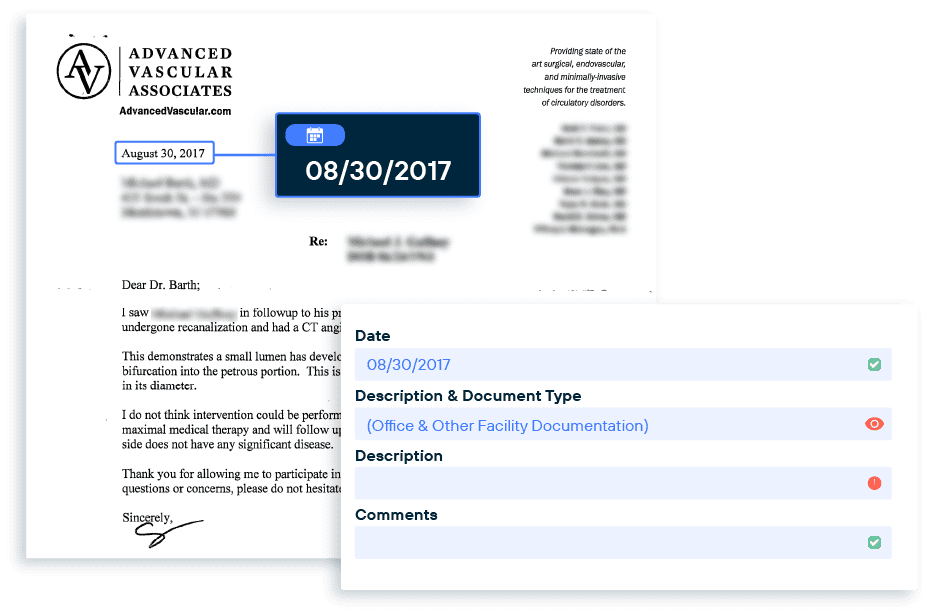
This hospital received this letter from a doctor outside their patient’s care network. It had no headers or prominent fields that could be quickly identified.
Semi-structured data is in between structured and unstructured data. It is unstructured with metadata. Metadata is simply data about data. It is behind-the-scenes information that helps you find, organize, maintain, and compare data. The metadata in semi-structured content contains enough information to allow data to be efficiently cataloged, searched, and analyzed.
For example, an email may seem unstructured with large bodies of text and images, but in the background, metadata capture essential data points like the header, time stamps, subject, delivery time, from, to, etc.
It’s easier to analyze than unstructured data but not as precise as structured data, a happy medium of the two.
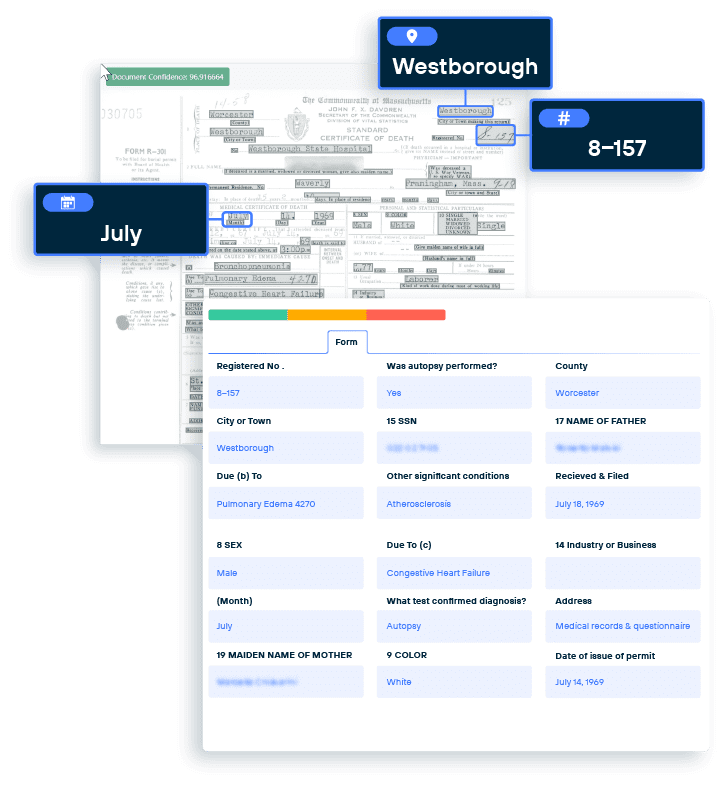
Organization B is structuring its vital records, including this death certificate. Although the actual certificate looks structured, it’s only semi-structured. Why? There are some handwritten responses, but Organization B has many variations of this certificate. Over the years their forms have changed. An organization could have ten modifications of the same form in a year, involving many manual human hours to determine what is a header and what is a field.
Every organization has unstructured, structured, and semi-structured content. What’s important is that you can consolidate and streamline all your data so that it’s easily understandable and accessible to your teams.
AI and machine learning are powerful tools that help you do this by automatically taking your content, no matter whether it has structure or lacks it, and turns it into a synchronized, digestible format.
DataBank’s Content Intelligence utilizes Intelligent Document Processing, including AI and human validation, to structure and streamline your data no matter the source. Once in your systems, your teams can immediately use it to respond quickly to your stakeholders, make better business decisions, and gain insights and analytics that help them make predictions.
Organizations that handle their records with efficient records management practices increase productivity and the overall effectiveness of corporate operations. If you don’t have one already, your organization should create and implement a records management strategy that sits at the heart of your organization’s records, processes, and procedures.
Hey, let’s go ahead and label this:
When implementing a strategy, consider the records management lifecycle that helps you manage and maintain records from creation to disposition. Every document has a different lifecycle which could run from a few days to permanently, so think about how you can tighten up your processes within each phase.
Here are best practices for records management following the records management lifecycle.
As with any strategy, start from the drawing board.
Determine, “Why are we implementing these practices?” Are you trying to help your employees and customers find documents more quickly, save on document storage costs, improve collaboration, boost security, or re-engineer manual processes? These goals will keep you aligned when developing your new records management process.
Next, you’ll want to choose your key metrics to track progress. Start with baseline metrics of historical data, and then compare with the results of your new records management practices – Here are some examples:
Once you have your goals and key metrics set, you can move on to other areas of the records management lifecycle.
This is the first step of the records management process, which starts with creating or receiving a physical or digital document related to your organization’s transactions or activities—for example, a financial report, a company announcement, or a new patient record.
Ideally, this would be automated.
Document indexing, or classification, is the process of using effective metadata naming practices to make storing, finding and sorting your digital files easier. The information is based on criteria you set that makes the most sense for your business. Through indexing, you make search and retrieval of information faster and easier for your end users.
A priority for any organization is to ensure strict data security and privacy measures are in place while documents are at rest, in transit, and in use. If security is lax, your data could be vulnerable to a breach. Electronic document and records management systems typically have built-in security features to keep information safe, with data encryption in transit through a strong SSL connection. If your company uses a cloud-based document management system, all your files are regularly backed up to the cloud.
A priority for any organization is to ensure strict data security and privacy measures are in place while documents are at rest, in transit, and in use. If security is lax, your data could be vulnerable to a breach. Electronic document and records management systems typically have built-in security features to keep information safe, with data encryption in transit through a strong SSL connection. If your company uses a cloud-based document management system, all your files are backed up to the cloud regularly.
Traditional document management practices encourage saving documents on local computers and non-controlled file sharing. Many risks are associated with paper documents being left out in the open, including in the printer output trays. Not to mention, paper documents are lost and difficult to find, leaving valuable information inaccessible when it’s needed most.
With on-premises systems, physical assets like servers, routers, and hard drives are purchased, installed, and ultimately replaced. They require expensive, time-consuming maintenance and have no backups in case of a breach or physical damage. Those are records you could lose without recovery.
When you opt for cloud-based document management, it’s easier to secure and maintain your infrastructure without investing in more in-house IT resources. Your cloud provider will likely have security built into their infrastructure, protecting you from something like massive data loss. Cloud document management systems also work for staff on mobile devices wherever there’s an internet connection, supporting secure remote work environments and greater team flexibility.
→ Check out The DataBank Cloud for OnBase
When you establish your goals, look at your current processes, and think about what you can automate within your records management process. Automation works well with simple, repetitive processes, like data entry and classification, because workflow steps are a snap to define and optimize. This results in saving your people’s time and your organization money and providing the opportunity to shift your team’s focus to higher-value work.
The final vital record management practice is to know when to delete documents or when to archive them. While some industry regulations dictate that certain records must be kept indefinitely, most records should be destroyed after a prescribed period. When the inactive records retention period expires, the records life cycle ends. Your records management policy should include annual reviews and assessments of internal and external compliance with your industry’s standards. It’s important to know exactly where your information is at all times.
The data world has changed; rather than pulling data to analyze and drawing conclusions to make business decisions, DMS or ECMs now work in real-time to deliver insights into your records and information. The data you want to see should align with your original goals, but you may discover more than what you came for – like how you can improve your service levels to customers, reduce operating costs, or minimize risks.
If you don’t have one already, it’s time to create a records management strategy. As best practice, really dig deep into your current process and see where there are gaps in each lifecycle phase. Beyond that, consider: