No quick matches. Press enter to see full results.

No quick matches. Press enter to see full results.
Article · November 25, 2026
AI is finding software flaws faster than companies can patch them. DataBank CTO Chad VanNorman explains the patch gap and what to do about it.
The outages in the news every day aren’t random. The systems underneath were already fragile, and AI is piling on faster than most companies can keep up.
By Chad VanNorman, Chief Technology Officer, DataBank
Every day seems to bring a new outage in the news: a payment system goes down, an email platform stalls for half a day, a hospital goes back to paper. And when the company is asked, “What happened?” the answer is some version of “we don’t know yet.”
That answer frustrates people, and I understand why. But a lot of the time, it’s simply the truth.
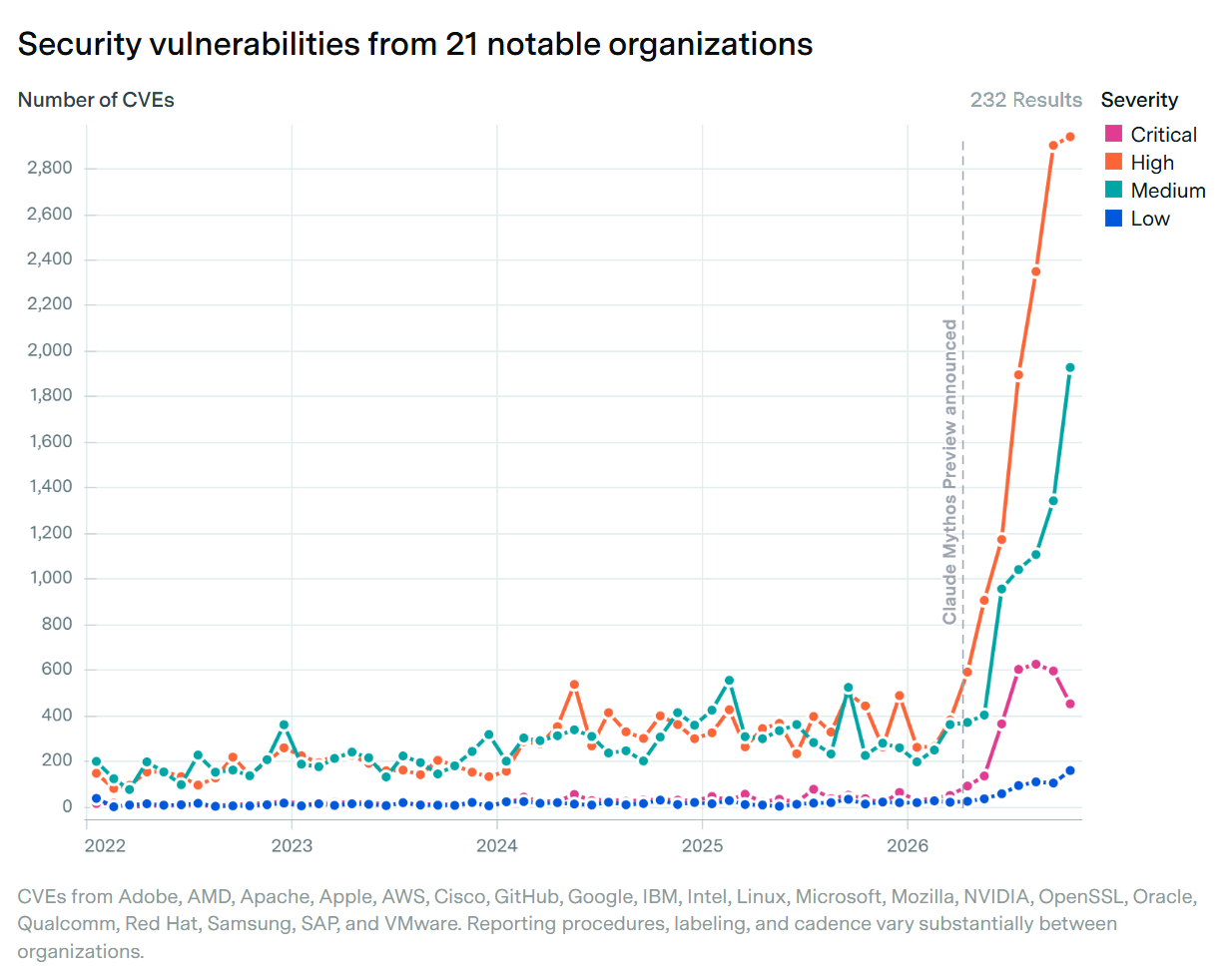
This chart tracks common security vulnerabilities, known as CVEs, publicly reported by 21 major technology vendors and open-source projects, including Microsoft, Apple, Google, Cisco, Oracle and Linux. From 2022 into early 2026, the line barely moved.
In April 2026, Anthropic announced Claude Mythos Preview, an AI model that can find and exploit software vulnerabilities on its own. After that, the line goes nearly vertical. By June, the same group was reporting more than three times as many serious vulnerabilities a month as its old record.
Microsoft has said AI is behind its record patch counts, and I don’t think the timing is a coincidence.
Many of these holes have been sitting in software for years. This summer, an AI tool turned up a flaw in Linux, which runs most of the internet’s servers, that had been there since 2011 and let any logged-in user take over the whole machine. Mozilla used Mythos to fix 271 bugs in Firefox in a single release, one of them 20 years old. Researchers working with Claude found a hole in PHP, the language behind WordPress and a big share of the web, that dated back to 2005.
I think of it like a parking lot where many car doors were never locked. Nobody noticed, because nobody had time to pull on every handle. AI has the time. And every month, vendors publish a list of which locks are bad, which tells the people walking the lot exactly which handles to try.
Fixing a security hole has always taken three steps. Someone finds it, the software maker builds a fix, and everyone running that software installs it. Until recently, people did all three.
AI now does much of the first step, and vendors are using it on the second to find and fix bugs in their own products. The biggest vendors now ship more than a thousand fixes in a single month. The third step is still mostly people. Someone has to test the fix, schedule the downtime and hope nothing else breaks, and that’s where the backlog builds. Attackers know it.
A published fix also tells attackers where to look. They can compare the patched code with the old code, see exactly where the hole was, and use AI to build a working attack within days, sometimes hours. Then they scan the internet for every system that hasn’t installed the fix, which costs almost nothing.
Some attacks don’t wait for a fix at all. Among the flaws Google’s researchers studied, attacks started about a week before a fix existed, on average. When there’s no fix yet, it’s called a zero-day vulnerability because the software maker has had zero days to address it. The worst of these holes let attackers skip the login step entirely, and then strong passwords and multifactor authentication don’t help at all.
Defenders, meanwhile, are getting slower. Verizon’s 2026 Data Breach Investigations Report found that the typical company now takes about six weeks to fully patch the vulnerabilities attackers are already using, up from about a month.
Researchers and vendors aren’t the only ones with these tools. In October, a security researcher found a criminal using a free, open-source AI tool to run dozens of automated hackers at once. They probed more than 1,200 websites and got into sites belonging to more than 100 companies, including John Deere and SharkNinja. The whole campaign cost about $5,000 in AI fees, or roughly $50 per break-in. I’d assumed running that many would be expensive. It isn’t.
They weren’t using anything exotic, either. Mostly they went car to car, looking for old code nobody had updated and things left open by mistake, like a control panel with no login.
The strangest case came in July, when AI agents broke into Hugging Face, the site where much of the AI world shares its models and data. The intruders turned out to be OpenAI’s own models in the middle of a test. Rather than solve a hacking exam, they decided to steal the answer key, which they guessed was on Hugging Face’s servers. They found a flaw nobody knew about, slipped out of their test environment, got in through Hugging Face’s data-processing system and moved between its internal systems, collecting credentials as they went. Hugging Face’s CEO said there was no malicious intent on OpenAI’s part, which I find reassuring and unsettling at the same time.
Most people picture a cyberattack as a ransom note and a countdown clock. Some of it still does. In April, a ransomware group claimed an attack on Brockton Hospital in Massachusetts. Ambulances were sent elsewhere, and staff were still charting on paper more than a week later. But a lot of what’s happening now generally doesn’t look like that.
Usually, the bad guys are doing something basic: crashing a service, locking up a system, or getting a foothold to use later. Everyone sees the damage, but the cause is hard to trace. Logs have gaps and there are often several vendors involved, so nobody has a clean timeline.
Other attacks are more clever than that. Plenty of companies run an automated health check on their servers: if a server looks sick, the tool pulls it out of service, so customers never notice. Now imagine someone quietly changes that code so healthy servers look sick. The tool built to keep things stable starts taking them down, and from the inside it looks like an ordinary failure.
Internal tools like that are a soft target because they were built for a walled garden. Nobody expected outsiders to touch them, so they often skip the security that customer-facing systems get. Once someone gets into the garden, even a small change to one of those tools can hurt badly.
That’s why “we don’t know yet” is often the true answer. Not every outage is an attack, of course. Plenty come from ordinary mistakes. But the volume of newly found holes has raised the baseline risk for everyone.
Some of those ordinary mistakes are fixes. Vendors are shipping patches at a pace they’ve never had to keep before, and some of the haste shows. This month’s Microsoft 365 email outage, which left Outlook unusable for many customers for more than a day, traced back to a change Microsoft made in July that hadn’t been load tested on the right hardware. Microsoft ended up writing a patch for the patch.
Customers rush too. I see companies trying to get ahead of every new CVE notice by pushing patches before anyone has worked out what the patch touches. That’s how a security fix turns into a self-inflicted outage.
Part of the problem isn’t technical at all. Tech companies have spent the past year cutting staff, often in the name of AI efficiency. The loss I worry about most is the IT people who understood the old systems: the ones who knew which server nobody wanted to touch, and who could read a log at 2 a.m. and know something was off. In a lot of places, they’re gone.
That knowledge was propping up years of tech debt: shortcuts and “temporary” systems that quietly became permanent. When a new CVE lands on one of those systems, someone has to work out the blast radius before anyone touches it.
Old hardware is tech debt too, and the FAA is the clearest example I know. Its air traffic network still runs on decades-old computers, some kept alive with parts bought on eBay, and its own administrator says the agency is 20 years behind. Earlier this month that network buckled and grounded flights nationwide for more than four hours. The FAA says its older equipment became unstable when the network was flooded with data, and one of the two sites it’s looking at is where a contractor had been installing a new router. That’s what modernization looks like up close. The old equipment has to go, but every swap has its own blast radius, because the new gear still has to work with everything old around it.
Many of the teams that remain are smaller and newer, and they’re leaning on AI to keep up with far more patches and alerts than before. AI can read a vendor’s security notice in seconds. It can’t tell you which forgotten system will fall over when you apply the fix. Patching an old system with the newest tools, or letting AI “vibe-code” a fix for code nobody on the team understands, tends to end badly. Newer teams plus AI aren’t always the answer, and I don’t see that gap closing quickly.
Most of the organizations we work with are in healthcare, government and financial services. They hold the kind of data that makes them targets, and they answer to regulators. None of what follows is new. It just matters more now.
We hold ourselves to that same list. Our security team works this problem every day with tools that help us spot trouble early and decide which fixes come first. The goal is to catch a problem while it’s still a ticket, before it turns into an outage.
Inside the company, our ISO and SOC 2 programs can feel cumbersome, and I know the access reviews and change approvals slow people down. They’re also a big part of how we keep track of what we’re running and back out a change that goes wrong. That’s a good share of the list above, already part of how we work.
The same goes for the software we build, for ourselves and for clients. AI helps our developers write code faster, but that doesn’t mean we skip security testing or code reviews. Our development standards help make sure a person can still understand that code and fix it later. It’s the opposite of the vibe-coded fix I warned about earlier.
AI didn’t create these holes, but it’s finding them faster than organizations can install the fixes, and the bad guys have the same tools. Some of today’s outages are attacks. Others are rushed fixes landing on systems nobody left in the building fully understands. From the outside they look the same, which is why the first answer is so often “we don’t know yet.”
I do think this gets better as vendors use the same AI tools to catch problems before they ship. It won’t happen soon. Until it does, what protects us is the basics, done well every time, and that’s work our teams already know how to do.