No quick matches. Press enter to see full results.

No quick matches. Press enter to see full results.
Topic
Everything DataBank has published tagged AI & Automation.

In "Understanding Intelligent Document Processing," DataBank IMX explores how Intelligent Document Processing (IDP) leverages artificial intelligence and human validation to convert unstructured content into structured, usable data. The article highlights IDP's ability to process various document types—including physical paper and digital PDFs—automating data extraction and reducing manual entry errors. Key benefits discussed include enhanced data accessibility, improved compliance through audit trails, and increased operational efficiency. DataBank's approach combines advanced algorithms with human oversight to achieve accuracy rates surpassing 98%, outperforming traditional manual or OCR methods. This fusion of technology and expertise enables organizations to streamline workflows, minimize data waste, and make informed decisions confidently.

In "A Step-by-Step Guide to Intelligent Document Processing," DataBank IMX provides a detailed roadmap for organizations aiming to implement Intelligent Document Processing (IDP). The guide emphasizes the importance of transitioning from physical to digital documents to enhance storage, retrieval, and collaboration. It advocates for investing in document management software with features like version control and automated workflows. Organizing and categorizing digitized documents systematically is highlighted as crucial for efficient access. The article also discusses leveraging Optical Character Recognition (OCR) technology to convert scanned documents into editable text, automating repetitive tasks to streamline workflows, and implementing robust security measures, including regular backups and access controls, to protect sensitive information. By following these steps, organizations can significantly enhance their document processing efficiency and overall productivity.

In "How Document Imaging Services Enhance Data Security and Compliance," DataBank IMX discusses the pivotal role of document imaging in bolstering organizational data security and ensuring regulatory compliance. By converting physical documents into digital formats, businesses can implement stringent access controls, reducing unauthorized access risks. Digital documents facilitate comprehensive audit trails, aiding in compliance with standards like ISO 27001 and HIPAA. Additionally, transitioning to digital reduces reliance on physical storage, mitigating risks associated with document loss or damage. Embracing document imaging not only streamlines operations but also fortifies data protection and adherence to regulatory mandates.

In "Feast Not Famine: Catastrophic Loss Impacts Insurers’ Ability to Service," DataBank IMX explores how a surge in catastrophic loss events is straining insurers’ operational capacity. From natural disasters to large-scale emergencies, these events highlight critical gaps in claims processing, customer communication, and backend infrastructure. The blog underscores the importance of modernizing systems with automation and digital tools to ensure service continuity, even under pressure. With the right technology, insurers can improve agility, maintain customer trust, and better navigate the complexities of high-volume, high-stakes claim environments.

See how automation and AI help upstream and midstream oil and gas companies improve data analysis, predictive maintenance, and reservoir management.

Robotic process automation (RPA) uses software bots to handle repetitive tasks. Learn how assisted and unassisted RPA can streamline work in any industry.

Discover the power of Intelligent Document Processing (IDP) and how it can transform your content into structured, usable data with minimal human interaction.
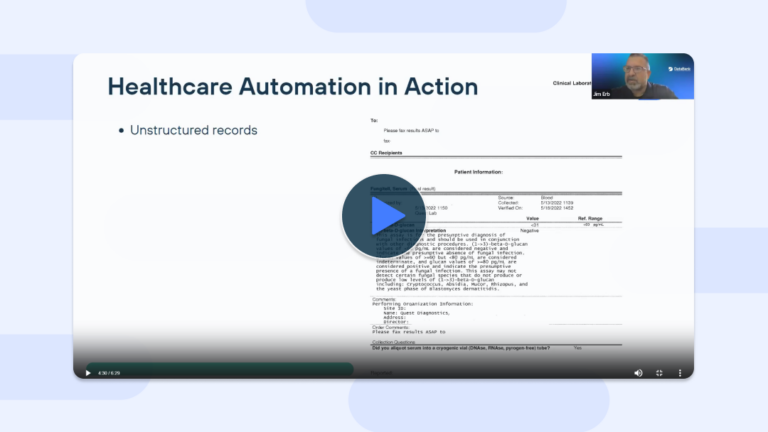
Learn how AI is revolutionizing medical records indexing and improving healthcare efficiency. Discover the latest webinar insights.

Discover the top trends for data-centric companies in 2023. Explore the benefits of moving your data to the cloud for improved security, cost-efficiency, and performance.

Don't fall for the misconceptions of AI. Learn how generative AI and Large Language Models are changing data processing and information extraction.