No quick matches. Press enter to see full results.

No quick matches. Press enter to see full results.
Article · October 6, 2026
Learn how to sequence healthcare payer digital transformation so it holds up. We cover the six domains, the CMS 2027 API rule, and how to fix intake before automating.
Payer digital transformation can help you reduce manual work, improve data exchange, and give members and providers better digital experiences. But to get those results, you have to follow a specific sequence:
DataBank supports healthcare payers across this entire transformation sequence, from information readiness assessment and document and data intake through content migration, ECM hosting, and managed services.
When the typical healthcare payer wants to transform its operations, it first spends significant time and money building a modern member portal where members can check benefits, find providers, and track claims online. And that works tremendously well to simplify routine interactions and reduce the work teams have to handle manually.
Until someone files an appeal.
According to the 2024 CAQH Index, 68% of medical claim attachments still arrive non-electronically, through channels like phone, mail, fax, and email.
If this appeal is part of that majority and arrives, for example, as a faxed letter with six pages of medical records, your team has got a lot of manual work to do.
A staff member has to print the fax, walk it to a scanner, and scan it into a shared drive. Then, they have to manually key the member ID, date of service, and appeal category into the claims system. If any of those fields are entered incorrectly, the appeal routes to the wrong queue and sits there until someone discovers the error.
So, even with your shining new digital portal, you still inherit many manual tasks when unstructured information that can’t sync directly with your portal comes in.
This article teaches you how to ensure your digital transformation project actually saves you time by following the right setup sequence.
DataBank IMX has been running document and data operations for regulated US organizations since 1991. We process over one billion records annually across owned mass scanning facilities in Pennsylvania, Indiana, Boston, and Texas, and we’re SOC 2 Type II certified.
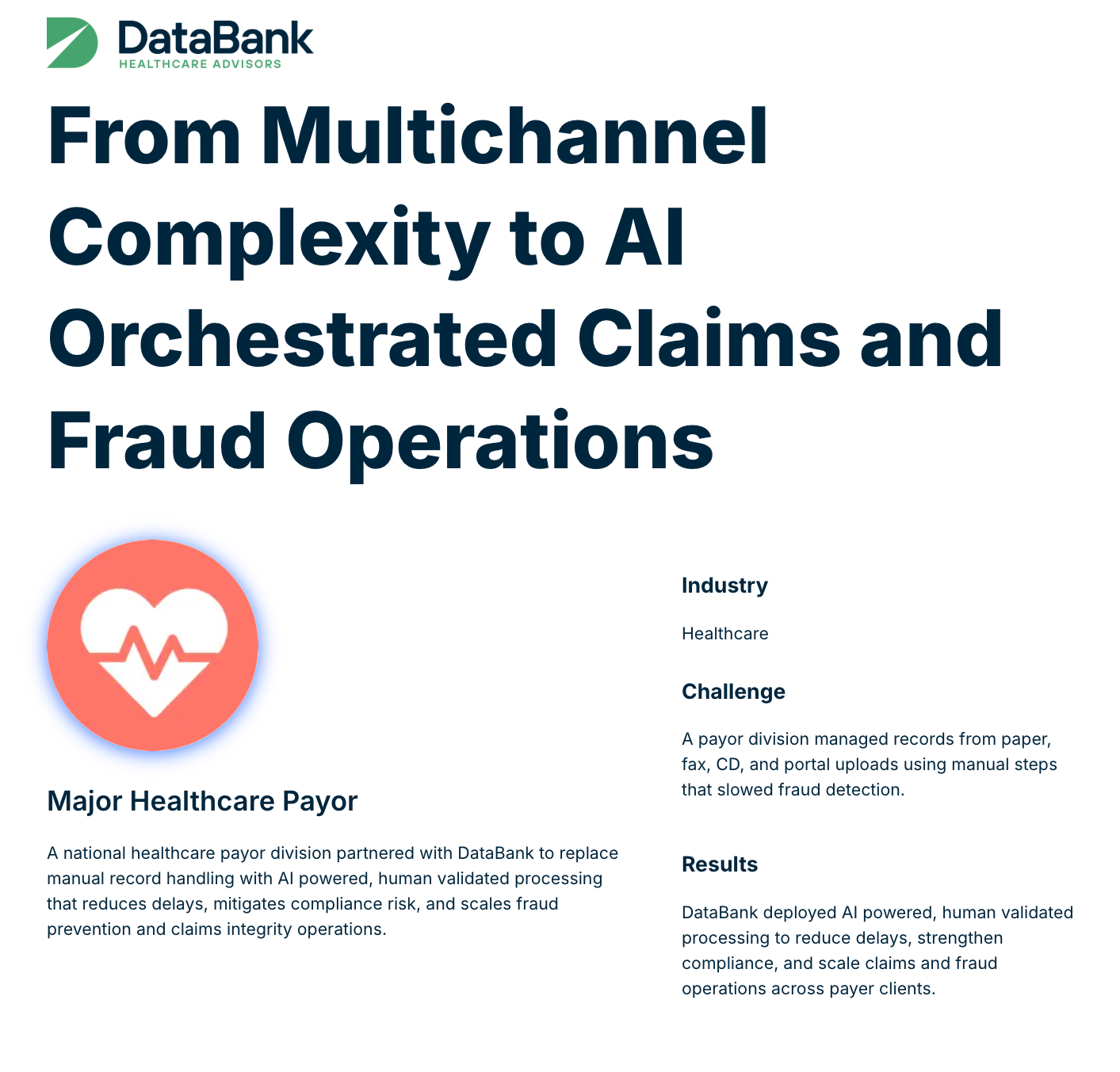
One major national healthcare payor partnered with us to transform multichannel claims and fraud operations through AI-driven document processing, and we helped them process 3.5M images in one month and build a correspondence pipeline capable of 176,550 letters per month, all while maintaining 100% SLA adherence.
This article is based on our experience helping health plans with claims and correspondence intake, content platform migrations, and the document-level work behind every automation initiative.
Healthcare payer digital transformation is a system-wide shift that replaces manual, paper-dependent, and legacy-system-bound operations with connected digital workflows. It covers how claims and prior authorizations enter the organization, how member data flows between systems, and how providers access plan information.
But most organizations tackle just one part of this, especially the parts members and providers interact with, and call that transformation.
But a plan that just builds a new member portal has modernized only one surface.
To capture the full value of digital and AI transformation, payers also need to ensure the transformation work reaches the data, operational core and systems every front-end experience depends on. That can mean digitizing intake, consolidating content platforms, modernizing legacy systems, and improving how data moves between them.
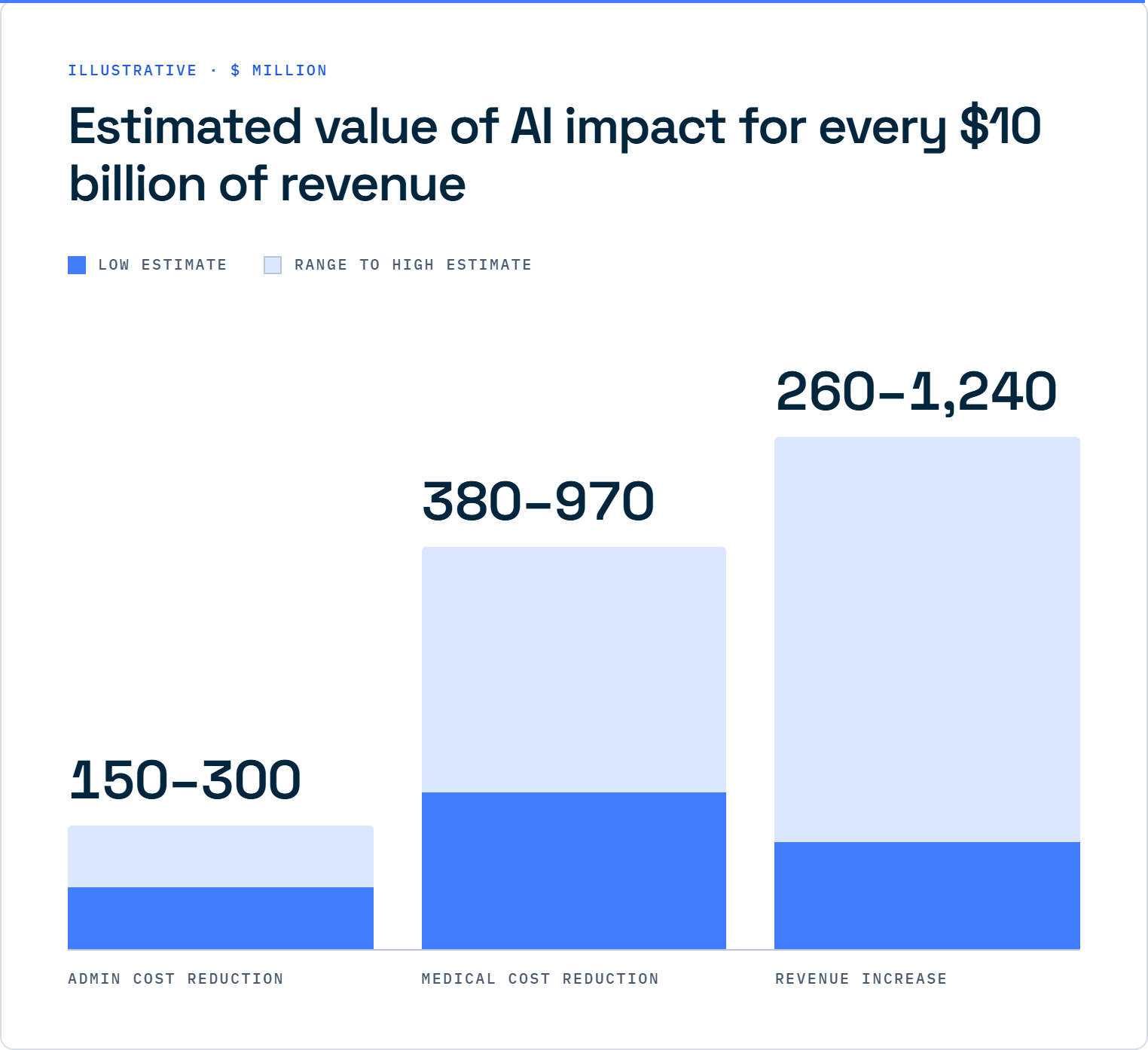
While that might seem like a lot of work, the potential value gain makes it worth it. McKinsey estimates that, for every $10 billion in payer revenue, AI solutions could save $150 million to $300 million in administrative costs, save $380 million to $970 million in medical costs, and increase revenues by $260 million to $1.24 billion.
Here are the four issues that tend to derail payer transformation programs from delivering the expected results:
Payer transformation programs often try to automate processes before all the information flowing through them is structured and fit for the automation system.
For example, a plan buys a workflow engine and connects it to its claims system even though half its incoming documents are unstructured images with no reliable metadata. So, the automation fires on with incomplete or inaccurate data, and exception queues fill up. Then, staff still end up doing the manual work they were trying to bypass with automation.
Claims operations owns one system. IT owns another. Compliance owns the records retention schedule. And none of these systems interact with each other. That creates gaps where documents get lost, and metadata gets entered inconsistently.
When a transformation initiative is launched, connecting these systems can require significant integration work. Without clear ownership of those integrations and the processes that span multiple systems, it becomes harder to coordinate the changes needed to succeed at digital transformation.
Payers know they need to move off legacy platforms. Legacy consolidation and modernization is a common part of payer transformation efforts. But knowing it and doing it are different things.

Legacy systems carry decades of configuration, custom integrations, and institutional knowledge that may not be documented. So most plans decide to keep the old system running alongside the new one for a while. Then, the temporary parallel operation becomes permanent and stalls modernization efforts.
Many payers have already tried a transformation initiative that promised results and delivered only a partial implementation. When the next one comes along, operations teams can be skeptical, and for good reason.
They’ve seen new systems that didn’t integrate with existing workflows. They’ve seen automations that created more exceptions than they resolved. Getting buy-in for a second digital transformation attempt is harder because the organization remembers what happened the last time.
Payer digital transformation doesn’t stop at one project. It touches six operational domains, each with its own systems, stakeholders, and failure modes. Understanding what each one involves makes it easier to sequence the work properly.
This includes the claims adjudication engine, enrollment and eligibility systems, and billing infrastructure.
For many payers, some of these systems still run on platforms that were built or configured decades ago. Modernizing them usually means migrating to a newer platform or adding an integration layer around the existing one. Either way, core administration sits at the center of the payer’s technology environment, so modernization must account for the systems and workflows connected to it.
This is where documents enter the organization. Claims, attachments, prior authorization requests, appeals, grievances, and provider correspondence are some of the document types that typically come in. They can arrive by mail, fax, email, portal, or EDI, and they don’t all come structured or in the same format.
That makes the intake workflow an important part of any payer’s digital transformation. It helps ensure there’s no gap between what payers receive and what reaches their claims systems.
This covers prior authorization, concurrent review, case management, and disease management. These processes rely on clinical and administrative information moving between the plan and its provider network.
The CMS Interoperability and Prior Authorization rule (more on that below) is also pushing payers toward more electronic data exchange, with key API requirements taking effect January 1, 2027.
Payers that still handle prior authorization through fax-based workflows and phone queues face both operational inefficiencies and a looming compliance deadline.
This domain covers provider directories, credentialing, contracting, and network adequacy. Provider data can be difficult to keep accurate when it’s maintained across multiple systems and sources. A digital transformation effort therefore needs a reliable source of provider information that can feed the systems that use it, from the member portal to the prior authorization engine.
This is where members actually see the plan: portals, mobile apps, digital ID cards, telehealth, and communications. EOBs, benefit booklets, SBCs, and plan notices also fall within this domain.
Many payers start their digital transformation here because it’s the most visible part of the operation. But a better member experience still depends on the accuracy of the information behind it. A portal showing incorrect provider data or stale claims status is worse than having no portal at all.
This covers population health analytics, risk adjustment, quality reporting (HEDIS, Stars), fraud detection, and the data warehouse infrastructure that supports them. These capabilities depend on clean, consistent, and timely data. That makes the upstream domains, particularly intake, provider data, and core administration, important sources for the analytics layer.
The right sequence matters for your digital transformation project because each step lays the foundation for the next. Skip a step or do things out of order, and you risk automating bad data, connecting systems with inconsistent information, or building analytics on a foundation that can’t support them. Here’s the right sequence to follow:
Before you buy a platform or launch an initiative, you need to understand your information’s current state. Audit how documents and data enter the organization, where they live, how they’re indexed, and whether they’re accurate enough to automate against.
You’ll want answers to specific questions: How many intake channels do you have? What format does each one deliver? What percentage of incoming documents require manual data entry before reaching a downstream system? How many content platforms hold the same types of documents, and do they use consistent metadata?
This assessment gives you a readiness baseline that you can use to measure progress throughout the transformation. You can also use the maturity model discussed later in this piece to score where you stand.
Once you know where the gaps are, intake is the first thing to fix. You need incoming documents, regardless of channel, flowing into a structured stream with consistent metadata.
For most payers, that means consolidating paper mail, fax, email, and portal submissions into one intelligent document processing pipeline. This pipeline then classifies, extracts, validates, and indexes each document before it reaches a downstream system. And the keyword is “before.” A claims document that reaches the adjudication engine with the wrong member ID creates an exception that costs far more to fix downstream than it would at intake.
This step is also where AI and human validation can work together. Intelligent document processing can classify and extract data from many standard document types, but it can struggle with handwritten notes, poor-quality faxes, and documents that contain multiple record types. Subject matter expert validation catches what the machine misses and creates a feedback loop that can improve extraction accuracy over time.
Most payers have documents spread across multiple platforms. There’s usually a legacy ECM for older records, a newer system for recent claims, and shared drives for correspondence. Each often has its own metadata schema, access controls, and retention rules, making it hard to maintain a consistent view of all the information.
Consolidation means choosing one governed platform or a connected pair) and migrating everything into it. That often involves mapping fields across systems that were never really designed to interoperate, validating that records transferred correctly, and maintaining a chain of custody. Effectively accomplishing those 3 tasks can be hard, and that’s what makes data and content migrations tasking.
But get them done right and the payoff is a single source of truth for every document in the organization.
That means when compliance needs a retention report, they run it from one system. When a claims examiner needs documentation on an appeal, you find it in that same place with the right metadata. And when an auditor asks for a record, you produce it with a full audit trail.
With intake stabilized and content consolidated, you can start retiring legacy systems that the organization has been maintaining alongside newer platforms. That’s the step everyone agrees is necessary, but everyone is reluctant to do. And it’s understandable. Years of configuration, custom integrations, and undocumented dependencies can make shutting down those systems feel like the wrong move.
If that’s how you are feeling, try an incremental migration to reduce the risk of something going wrong. Move one function or document type at a time, validate that the new system handles it correctly, and then decommission the old one once the replacement has been in production long enough to prove itself.
This approach takes longer than simply cutting out the old systems, but it limits the risk of a failed migration disrupting production.
Cloud migration adds another layer to consider. If you’ve got on-premises ECM platforms that need to be moved to the cloud, you need clear answers on where the data lives, who can access it, and how it’s protected before migrating. This is especially important if your plan handles PHI.
Once your data is trustworthy, you can then build APIs and integrations to connect it to the partners and systems that need it. Think your claims system, care management platform, provider directory, and member portal.
That is where the CMS 2027 API requirements (covered below) come into play. The FHIR-based APIs required by the rule aren’t just a compliance checkbox. They’re a signal that the industry is moving toward interoperability.
For payers covered by the rule, building your APIs on clean, well-governed data will make it easier to meet the requirements and support the systems that depend on them.
This is the last step, and for good reason. With clean data, consolidated platforms, and working APIs, you can build workflows that run without constant human intervention. Workflow and process automation at this stage means you are routing claims to the right queue based on reliable metadata, triggering prior auth decisions based on complete clinical data and generating member communications from accurate benefit information.
When you do this automation step last, you’ll see a clear difference in your exception rate. Automation built on clean, well-governed data produces little to no exceptions and less manual rework. That’s the efficiency gain that makes your digital transformation sustainable.
This model gives you a way to score where your organization’s information stands and spot the gaps to close before moving to the next step:
That gap between where you stand and Level 4 is the information-readiness gap, and your ability to close it determines whether your automation investments deliver the expected results.
The CMS Interoperability and Prior Authorization Final Rule (CMS-0057-F) was finalized in January 2024. It requires certain payers to implement and maintain FHIR-based APIs, with the main API requirements taking effect January 1, 2027. CMS estimates the rule will save approximately $15 billion over ten years by reducing friction in the prior authorization process.
Medicare Advantage organizations, Medicaid managed care plans, CHIP managed care entities, and Qualified Health Plan issuers on the Federally Facilitated Exchanges. State Medicaid and CHIP fee-for-service programs have until January 1, 2027, to comply.
The rule mandates three new FHIR-based APIs: the Provider Access API, which gives in-network providers access to specified patient claims, encounter data and clinical information; the Payer-to-Payer API, which lets plans exchange data when a member switches coverage; and the Prior Authorization Requirements, Documentation, and Decision (PARDD) API, which lets providers submit, track, and receive decisions on prior auth requests electronically.
It also expands the existing Patient Access API to include certain prior authorization information.
Urgent prior auth requests must receive a decision within 72 hours, and standard requests must receive a decision within 7 calendar days, down from the previous 14-day window. These requirements already took effect on January 1, 2026.
Payers must publicly report approval and denial rates, processing times, and denial reasons annually. They must also disclose specific denial reasons to providers at the time of denial.
P.S.: If you’ve followed the sequencing above, you’ve already done much of the foundational work that ensures these APIs connect to clean data. So compliance becomes a natural extension of your previous digital transformation efforts.
But if you haven’t and still have data quality and interoperability problems, for example, an information-readiness gap, the APIs will only expose those problems to the members and providers relying on the data they return.
Every department that handles documents tends to develop its own method of storing and indexing them. And those methods rarely match. Claims might use one system with one set of index fields, Appeals another, while Provider Relations relies on a shared drive.
That means locating a document can become a completely different process, depending on which department you need to pull it from. This makes it difficult to set up consistent automation workflows for processes that cross departmental lines.
Inconsistent provider data is a well-known industry challenge, but member data can have similar problems. A member’s demographics might differ between the enrollment system, claims system, and member portal, and the same can happen with provider information across credentialing, contracting, directory, and claims systems.
Without a reliable source of truth, downstream systems can inherit inconsistent information from the systems feeding them. That can affect everything from claims processing to what members and providers see through digital channels.
Health plans must comply with federal and state retention requirements, which vary by document type, line of business, and jurisdiction.
Add legal holds to those retention mandates, and you’ve got another layer of complexity around how you must handle information and documents. For example, a document that would otherwise be eligible for destruction has to be preserved if it’s subject to litigation or a regulatory inquiry.
Managing all those requirements across multiple platforms can make it difficult to apply and monitor retention policies consistently. That’s why most payers consolidate their information onto a single governed platform to simplify records management and easily meet regulatory obligations.
Organizational leaders may hesitate to approve a transformation initiative when they’re not convinced the time, cost, and disruption will be worth it.
To get past that resistance, start with a smaller, measurable project and show early wins before asking the organization to commit to the full roadmap. A measurable improvement in intake accuracy or a claims queue that actually clears will do more for buy-in than any executive presentation.
DataBank IMX is a document and data operations firm for regulated U.S. organizations. We handle much of the foundational work behind payer digital transformation, including intake, content management, and legacy migration steps that often stall programs.
Our approach maps directly to the sequence above. We start with your information readiness, assessing how documents and data enter your organization and where data inconsistencies start.

We then stabilize intake through high-volume document scanning, intelligent document processing, and subject matter expert data validation. Your claims, correspondence, and attachments reach downstream systems clean and indexed.
Next, we consolidate your content platforms through data and content migrations, mapping metadata across legacy and modern systems and maintaining chain of custody. We then host and manage the resulting environment through ECM cloud hosting and managed services.
Our entire operation is US-based, so we can handle your protected health information that has data-residency requirements. We also support HIPAA compliance through SOC 2 Type II certified operations.
If your transformation program has stalled because the underlying information isn’t ready, we can solve that. Connect with our team to start your information readiness assessment and see the gap you have to close.
If your plan has already invested in a digital transformation initiative but the result hasn’t been promising, take a closer look at how your current intake process is set up.
Healthcare payer digital transformation is a sequenced set of operational changes that starts and depends heavily on the underlying information before working outward toward automation, analytics, and interoperability.
Audit how documents and data enter the organization, where they live, and whether they’re accurate enough to automate against. Only when that intake process has been unified across all channels, document types, and formats should you move on to the next step in the sequence.
Don’t want to handle all this alone? DataBank’s transformation experts can help you assess your information readiness and build the foundation for the next stage of your digital transformation.
Start with an information readiness assessment. Check where documents and data enter your organization, where they are stored, and whether they’re accurate enough to automate against. That assessment tells you which of the six domains needs attention first and keeps you from automating on top of bad data.
They can fail when payers automate on top of poor-quality information. If incoming documents aren’t consistently classified, extracted, and validated before reaching downstream systems, the automation produces more exceptions and manual work. Siloed ownership, legacy dependency, and change fatigue can also cause program failures.
The CMS Interoperability and Prior Authorization Final Rule (CMS-0057-F) requires affected payers to implement three FHIR-based APIs by January 1, 2027. These include the PARDD API, the Provider Access API, and the Payer-to-Payer API. CMS estimates it’ll save approximately $15 billion over ten years.
It means your documents and data are accurate, consistently indexed, and housed in governed systems that downstream processes can rely on. A plan with high information readiness can automate with confidence because the data feeding its workflows is clean. A plan with low readiness will see high exception rates and need lots of manual rework.
It depends on the scope and the starting point. A realistic timeline for the full sequence is two to four years for a mid-sized plan. Trying to compress it by skipping steps, especially intake stabilization and content consolidation, is how programs fail after you’ve invested significant time and money.