No quick matches. Press enter to see full results.

No quick matches. Press enter to see full results.
Read enough headlines and you’d think every company is a few months away from running on autonomous agents, but that isn’t the reality for most organizations.
I grew up around this industry in Oklahoma City, and at DataBank we’ve worked with more than 40 oil and gas operators, midstream companies and service firms. The people I talk to aren’t against AI. Most of them are already using it somewhere. What they’re running into is more basic. AI can only work with records you can find and actually trust. For many operators, those records aren’t in shape yet. That gap, between what AI can do and what your records will let it do, is where most projects either pay off or stall.
Oil and gas isn’t dragging its feet on AI. When 451 Research surveyed energy and utilities organizations this year, 27% said agentic AI is already integrated across their organization, compared with 18% across all organization types. Energy organizations have always focused heavily on innovation.
But about a third of the AI projects energy and utilities companies started in the past year have already been killed, compared with about a quarter in other industries. Only 37% are delivering business value. When people explained what went wrong, the top answers were system integration, data quality and data access.
When we talk with people at oil and gas events, they almost never lead with AI. They lead with “I can’t find the record I need,” or “I found it, but I’m not sure it’s the current version.” If your team doesn’t trust the information it has today, putting AI on top of it is like strapping rockets to a garbage can. You’ll go fast, but you won’t end up anywhere you wanted to go. Gartner says roughly the same thing, more politely: it predicts that through 2026, organizations will abandon 60% of AI projects that don’t have AI-ready data behind them.
The pile keeps growing, too. Enverus counted $38 billion in U.S. upstream M&A in the first quarter of 2026, the biggest quarter in two years, and expects more consolidation to come. Every one of those deals comes with someone else’s leases, title files, division orders and well histories, usually on paper and filed however the last owner liked it.
Land teams feel it first. One in-house landman told Permian Basin Oil and Gas Magazine in June that he can only use AI about 10% to 15% of the time outside the office, because so much of what he needs was never digitized. No AI tool can fix that on its own.
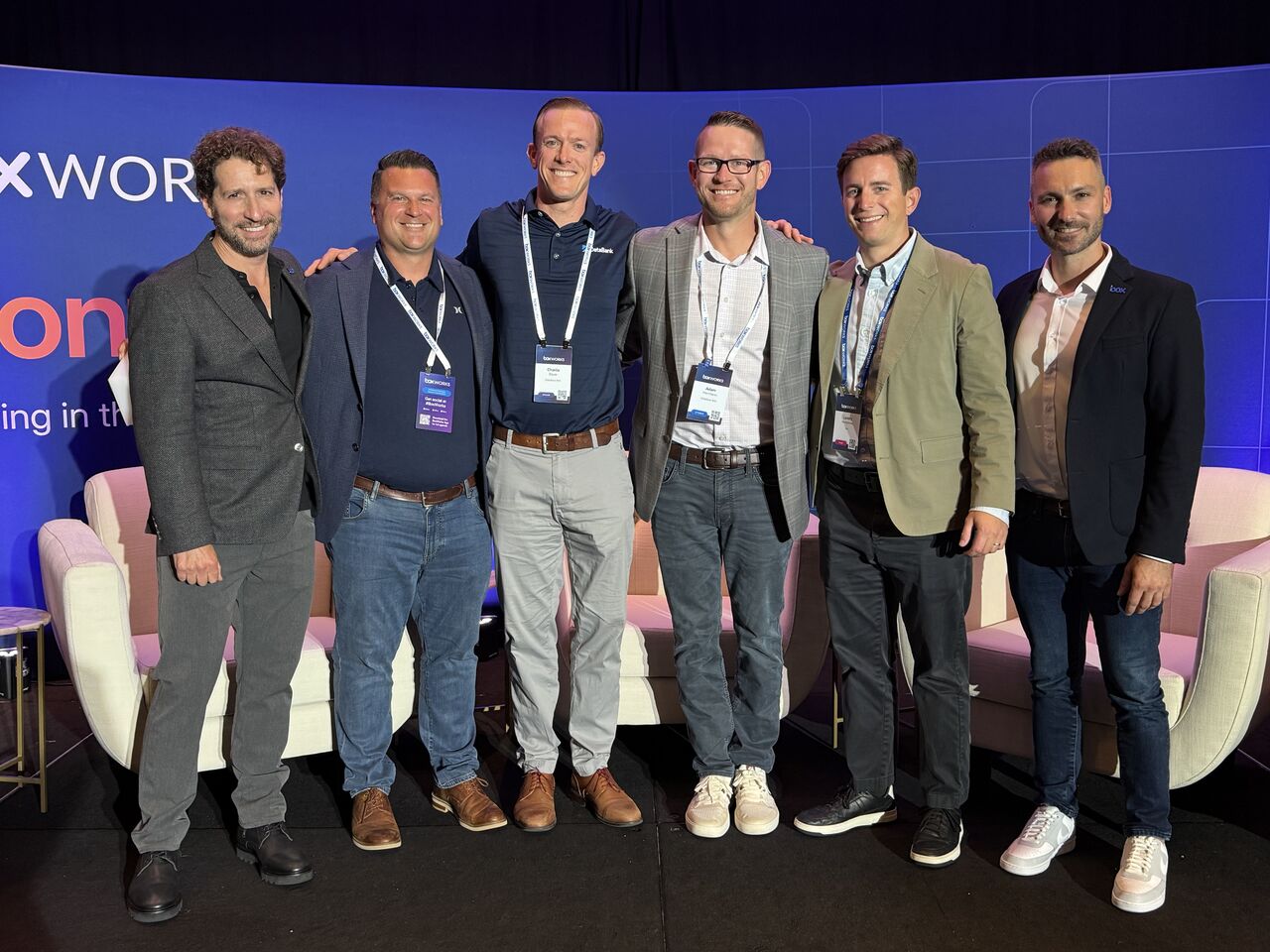
I heard a good example of this in September at the Box Content + AI Summit in Dallas. Nena Calligaro, senior cloud services and infrastructure leader at Merit Energy Company, sat down with our chief revenue and operations officer, Adam Herrmann, to discuss how Merit handles the records that accompany each acquisition. Before 2017, those files arrived in boxes and went onto shelves, and Merit’s engineers and land staff would dig through physical files to find what they needed.
Since Merit started working with DataBank, its land and production records have been digitized, indexed and consolidated into one repository, and files from new deals go through an automated intake process. When an office flood hit, Merit didn’t lose any data. (Here’s the full case study.) Even so, Nena was candid that paper hasn’t gone away: “a lot of the transactions that we see, we’re still seeing a lot of physical files.” That’s the reality for almost everyone in this industry, and it’s why the operators who get value from AI are the ones with a dependable way to bring paper and digital records together as they arrive.
The order we see work is pretty simple. Get the records in when the deal closes. Clean them up so there’s one current version of each document, tied to the right well, lease or tract. Then put AI to work on narrow jobs you can check, like lease provision lookups and due diligence questions, and build from there.
Oil and gas is a show-me industry. People here have sat through plenty of pitches, and they can spot hype from a mile away. Silicon Valley can mistake that skepticism for resistance, but this is the same industry that made horizontal drilling and real-time production monitoring standard practice. It adopts new technology when the technology proves itself in the field. AI will be no different, and it’ll prove itself fastest on records the team already trusts.
So if you’re being asked about your AI plan and you’re not sure your records are ready, start small. Pull the files from your most recent acquisition and take an honest look. They’ll tell you pretty quickly how much work sits between you and AI that actually pays off. And if you want a second set of eyes, our team is happy to help.
Most of them stall on data. Energy companies in 451 Research’s 2026 survey named system integration, data quality and data access as their biggest technical obstacles, and they shut down AI projects at a higher rate than other industries.
Bring them in as soon as the deal closes. Digitize and index the files before they go into storage, match them to the assets you bought and merge them into one repository so land, engineering and accounting are all working from the same source.
We are proud to share that DataBank has been recognized as a top performer in the 2025 Hyland Global Partner Awards, earning 3 of the 5 total partner awards presented this year, including Global Partner of the Year.
Global Partner of the Year
Awarded to the partner demonstrating the greatest overall impact on Hyland’s global strategy, growth, and customer success.
Industry Excellence Partner of the Year: U.S. & Canada
Recognizing DataBank’s strength in delivering industry-focused solutions that drive measurable value across complex and regulated environments.
Performance Partner of the Year: U.S. & Canada
Honoring sustained performance, operational excellence, and the ability to scale results for customers.
Winning three of the five total awards places DataBank at the forefront of Hyland’s global partner ecosystem and underscores our leadership position in the market.
These Hyland honors follow another significant milestone earlier this year, when DataBank was named Box’s New Partner of the Year. Together, these recognitions highlight a consistent theme: DataBank is winning, growing, and scaling impact across leading content and information management platforms.
Our ability to build trusted partnerships, deliver quickly, and produce measurable outcomes is being recognized across ecosystems, not as one-off successes, but as a result of a repeatable, disciplined approach to partnership and delivery.
Hyland is making strategic shifts to further strengthen its platform, partner ecosystem, and industry alignment. With increased emphasis on cloud, automation, and partners who can deliver outcomes at scale, the opportunity for DataBank continues to expand.
Our long-standing partnership with Hyland, combined with our growing presence across complementary platforms like Box, positions DataBank to help clients navigate change, modernize their information environments, and realize long-term value.

Learn more about Hyland + DataBank
Read Hyland’s Partner Awards Announcement
Know Before You Go: CommunityLIVE 26 with DataBank
CommunityLIVE 26 is almost here, and the DataBank team is excited to welcome clients, partners, and attendees to Orlando for a packed week of learning, networking, innovation, and fun. Whether you’re attending technical trainings, exploring new Hyland solutions, or connecting with peers and the DataBank team, we want to make sure you’re prepared for an incredible week.
Event Basics
CommunityLIVE 26 will take place May 30 – June 3 at the Gaylord Palms Resort & Convention Center in Kissimmee, Florida. Throughout the week, DataBank will host activities, networking opportunities, and collaborative sessions designed to help attendees get even more value from the conference experience.
Key Dates
You’ll also be able to find the DataBank team throughout the week in the Suwannee meeting rooms and at the Wellness Lab by DataBank booth in CommunityCENTRAL.
What to Expect Throughout the Week
Sunday, May 31 – Welcome Happy Hour
Kick off CommunityLIVE with DataBank at our Welcome Happy Hour from 5–7 PM in the Suwannee 1 Room. This is a great opportunity to settle in, connect with the DataBank team, grab some swag, and meet fellow attendees before the conference officially begins. Drinks, appetizers, and a casual atmosphere will help start the week off right.
The evening is also a great time to connect with your DataBank representatives and coordinate plans for the week ahead.
Monday, June 1 – DataBank Keynote + Ingenuity Awards Party
Monday is packed with activity. After morning technical trainings, attendees are invited to the DataBank Lunch Keynote at 12 PM in Suwannee 1. DataBank CEO Matt Charlson will share insights on modernization, AI, automation, and the future of organizations leveraging OnBase and CIC solutions.
That evening, the excitement continues with the annual Ingenuity Awards Party, reimagined this year as the DataBank Tiki Club at theMargaritaville at Universal CityWalk. Expect food, drinks, entertainment, and the announcement of this year’s Ingenuity Award winners.
Transportation will be provided from the Gaylord Transportation Lobby. Please arrive no later than 6:40 PM as buses will keave between 6:45 PM and 6:50 PM, with return buses running later in the evening. Attendees are encouraged to arrive at the pickup area on time to ensure a smooth departure.
Wellness Lab by DataBank
New this year, DataBank will host the Wellness Lab by DataBank booth in CommunityCENTRAL located in the Osceola Ballroom. Throughout the week, attendees can stop by to connect with OnBase and CIC experts, enjoy smoothies and wellness-themed swag, and discuss the health of their systems, processes, and data.
The booth is designed to be a comfortable place to recharge, ask questions, and continue conversations sparked during conference sessions.
Wednesday, June 3 – Next Step Forum
Before heading home, attendees are invited to the DataBank Next Step Forum from 9–11 AM in Suwannee Room 1. This collaborative session is designed to help attendees turn ideas from CommunityLIVE into practical next steps.
The forum will include:
After several days of sessions, product updates, and networking, this forum provides an opportunity to step back, organize key insights, and begin building a plan for applying what was learned at the conference.
Check out the agenda
Before You Arrive
To make the most of your CommunityLIVE experience:
We’re looking forward to seeing everyone in Orlando and making CommunityLIVE 26 an unforgettable week filled with innovation, collaboration, and connection.
Box and DataBank announced a strategic partnership focused on helping organizations transform business operations through intelligent content management. The partnership combines Box’s Intelligent Content Management platform with DataBank’s expertise in process automation, information governance, and digital transformation services.
“Our services and solutions will help both leverage Box AI as well as feed valuable context from unstructured data into data sources managed by Box.”
DataBank helps organizations modernize legacy content environments, improve information accessibility, and create more connected digital workplaces through the partnership. For DataBank clients, content modernization is not just about where information is stored. It is about making content accessible, governed, secure, and connected to the workflows that depend on it. DataBank helps organizations implement, integrate, govern, and operationalize Box in complex environments where compliance, collaboration, and AI readiness matter.
Learn more about Box + DataBank
Read Box Partner Awards Announcement
This is why oil and gas document automation often underperforms. Not because of the tools, but because of the inputs. But this leads us to ask why is this more complex in oil and gas?
But without consistent oil and gas document management processes, companies inherit data challenges that persist long after the deal closes. DataBank supports this process by normalizing and structuring acquired document sets so they can be integrated quickly and used with confidence.
Field teams often need fast access to accurate records but the infrastructure to support that isn’t always in place.
This phase is critical and often overlooked. However, this is where DataBank’s service-driven model stands out. Combining advanced technology with human validation to ensure metadata accuracy and proper classification.
Only when these steps are complete can oil and gas document automation deliver consistent value.
Intelligent document processing (IDP) plays a key role in modern oil and gas document management strategies. It enables organizations to:
But IDP is only effective when applied to well-structured, validated documents. Without that foundation, results remain inconsistent.
When oil and gas document management is done correctly:
Beyond efficiency, this improves decision-making. Well-managed documents support:
In some cases, improving document control and accessibility can even increase asset value by improving diligence readiness and ownership clarity. DataBank’s intelligent document processing solutions are built to extract, validate, and structure critical data from oil and gas documents at scale.
Several industry trends are bringing this challenge to the forefront:
Today, the focus is shifting toward readiness:
This shift is what enables automation to succeed. DataBank works with organizations to make this adjustment. Moving from simple storage to fully operational, automation-ready document environments. Oil and gas companies don’t lack automation technology. But many automation initiatives depend on documents that were never prepared to support them. Improving oil and gas document management, especially at the point where documents enter the business, is what unlocks the full value of automation.
The Work Isn’t the Problem. The Waiting Is.
Most organizations are not drowning in documents because they lack systems like OnBase. They are drowning because too much of the process still depends on people stopping what they are doing to review, validate, search, compare, confirm, and move information forward. A workflow may technically be automated, but if a packet still waits in someone’s queue for review, the business is still operating at human speed. That distinction matters more now than ever.
Across industries, operational pressure is rising from every direction. Customers expect immediate responses. Teams are being asked to do more without adding headcount. Processes span multiple systems, multiple departments, and increasingly complex compliance requirements. Meanwhile, the volume of information continues to grow. Friction rarely comes from the document itself. It comes from the pauses between decisions.
That was the central theme during a recent DataBank and Hyland webinar focused on agentic document processing and the Hyland Content Innovation Cloud (CIC). Rather than presenting AI as a futuristic replacement for enterprise systems, the conversation focused on something far more practical: reducing the manual burden that still slows down critical business operations.
Not replacing workflows. Removing the drag inside them.
So where does the process usually break down?
Enterprise workflows often look efficient from a distance. Documents are digital. Records are centralized. Routing rules exist. Content lives inside structured repositories like OnBase. On paper, the process appears to be modernized. Then reality shows up.
Someone still has to:
Individually, those tasks feel minor. Together, they create operational lag that compounds across the organization.
The webinar demonstrated this through a lending workflow used by credit unions processing indirect auto loans. Dealerships submit large document packets on behalf of borrowers. Those packets can contain dozens of pages, different document types, varying formats, and inconsistent ordering depending on the dealership. What made the workflow notable was not just the AI itself, but how it extended the existing OnBase environment instead of replacing it. The content, routing, governance, and downstream processes remained connected to the systems teams already relied on.
Historically, teams manually reviewed every submission. If something was missing, a signature, a disclosure, a supporting document, the issue might not be discovered for hours. Sometimes days. By then, the borrower had already left the dealership, forcing everyone back into a process nobody wanted to repeat.
The operational cost was not just slower processing. It was interruption. Employees were spending their time policing documents instead of moving business forward.
This is where we need to notate the difference between automation and intelligent action.
Traditional OnBase automation has always been effective at routing work once the rules are clear. The challenge is everything that happens before the workflow can confidently move forward. That is where agentic document processing changes the equation.
Instead of relying on rigid templates or narrowly structured extraction models, AI agents can evaluate content contextually. In the webinar example, the system was able to:
Instead of creating disconnected AI workflows outside the enterprise content ecosystem, these agents were operating alongside existing OnBase processes and repositories.
What stood out was not the extraction itself. It was the ability to handle variation without constant reconfiguration. Different dealerships submitted different packet structures. Documents appeared in different orders. Forms varied slightly from source to source. The agents still understood what they were looking at.
That flexibility is important because most enterprise bottlenecks are not caused by standard processes. They are caused by edge cases, inconsistencies, and the endless stream of “almost right” submissions that require human attention. Organizations have spent years trying to standardize inputs. AI agents are beginning to make that dependency less critical.
The lending example resonated because the operational pattern is familiar almost everywhere. Healthcare teams manage intake packets, referrals, authorizations, and release-of-information requests that require layered validation before action can happen. Manufacturers process supplier documentation, quality records, shipping paperwork, and compliance files across disconnected systems.Government agencies work through case files, citizen submissions, and records requests that often depend on manual review before decisions move forward. The industry changes. The bottleneck does not.
Many of these organizations already manage these processes inside OnBase today. The challenge is not document storage. It is reducing the manual review layers surrounding those workflows. Somewhere in the process, people are still acting as human middleware between systems. That is where organizations are now focusing their AI strategies. Not on replacing expertise, but on removing repetitive intervention points that drain time and attention.
AI Adoption Is Becoming an Operational Decision, Not a Technology Decision.
One of the more grounded points from the webinar was that organizations are not looking for wholesale reinvention right now. Most enterprises have already invested heavily in platforms, workflows, governance structures, and content management systems. The hesitation around AI is rarely about curiosity.
It is about disruption.
Leaders do not want to:
That is why the positioning around the Content Innovation Cloud matters. The approach discussed was not centered on replacing OnBase, but on layering intelligence into existing environments. That lowers the barrier significantly.
Organizations can start with:
Then expand from there. That incremental model is likely why these conversations are moving from experimentation into production planning. The focus is no longer “Where can we test AI?” It is becoming “Where is manual effort slowing the business down the most?”
Speed is the easiest result to measure, but it may not be the most important one.
The deeper operational value comes from consistency. When repetitive review work is handled intelligently:
In the webinar, one comment stood out: “The one thing I really hate is waiting for stuff.” That sounds simple, but it captures the real business issue perfectly. Most operational frustration comes from waiting:
Agentic document processing is ultimately about reducing those pauses. Not by eliminating people, but by reducing the amount of routine analysis humans need to perform before work can continue.
The most practical guidance from the webinar had little to do with AI models or technical architecture.
It came down to asking better operational questions.
Where are employees still manually entering information?
Where are people spending time validating completeness?
Where do workflows stop simply because someone has to check something?
Where are employees searching for answers across systems?
Those are usually the first signs that a process is ready for intelligent automation. For many organizations, the next evolution of OnBase will not be rebuilding workflows from scratch. It will be adding intelligent decision support directly into the processes they already trust.
And increasingly, that is the pressure point organizations are trying to solve.
Access the Recorded Session Now
If you’re responsible for the stability and long-term direction of an OnBase environment, you’ve likely heard a lot about Hyland’s Content Innovation Cloud (CIC), and you may be wondering what it actually means for your platform, your workflows, and your roadmap.
What changes?
What stays the same?
What does the first step look like?
The best first step starts with clarity. Hyland CIC is not a replacement for OnBase. It is designed to extend capabilities without forcing immediate migration, giving you a modern way to introduce new value while protecting day-to-day operations. In other words: your OnBase environment remains the operational core, while Hyland CIC helps you modernize in stages, on a timeline that fits real constraints like resourcing, governance, risk tolerance, and business continuity.
Before you think about the “when” or the “how,” it helps to anchor on a few fundamentals that shape a safe modernization plan. Hyland CIC is an evolution, not a replacement. The simplest way to think about Hyland CIC is that it adds new capabilities while your OnBase environment continues to deliver value. No need to start over, and you can keep business-critical workflows running while making smart upgrades over time!
Once you remove the fear of replacement, the next question becomes: what does Hyland CIC actually add? At a high level, CIC introduces capabilities that support modernization in:
That last point—federation—is especially important, because it sets the tone for how modernization actually happens: not all at once, and not by breaking what already works. This is why,
Modernization is staged for a reason
Modern capabilities around unstructured content
Content Intelligence (AI/ML): Hyland CIC helps organizations apply intelligence to content-heavy work—improving how content is interpreted, categorized, and used across processes. The outcome isn’t “AI for AI’s sake.” It’s practical: reduced manual effort and better consistency in content-driven operations.
Process Automation: Hyland CIC expands automation opportunities tied to real workflows. That includes orchestration and enablement that reduces repetitive tasks and helps teams standardize processes—without requiring a disruptive overhaul.
Federation (connection without disruption): Federation is the modernization enabler that makes the full story. It supports connecting to existing repositories—OnBase—so organizations can introduce new capabilities in stages while keeping critical systems operational.
So, what’s the safest first move?
A practical starting approach looks like this:
This is what “staged adoption” is meant to look like: controlled, measurable steps that build confidence. Even with the right philosophy, modernization can stall without clear guidance. Leaders often need to know what this means for their environment. DataBank helps OnBase organizations modernize without disruption by focusing on:
The goal is not to push change. It’s to make the path forward understandable—and achievable.
For more information, watch the on-demand session:
“Decoding Hyland’s Content Innovation Cloud — What This Really Means for OnBase Customers”
Dawn Sophia, a Solution Architect at DataBank breaks down what Hyland CIC is, how it aligns with OnBase today, and what modernization can look like through practical, low-risk stages.
Access the Recorded Session Now
For decades, Hyland has been one of the most trusted names in enterprise content management (ECM). Now, it’s stepping into a new era — one defined by AI, intelligent automation, and semantic understanding.
Through innovations like the Content Innovation Cloud (CIC), Hyland is transforming content from a static repository into a living, connected knowledge ecosystem. But technology alone doesn’t deliver transformation. To unlock its full value, organizations need a partner who can bridge bold innovation with real-world execution.
That’s where DataBank IMX comes in. With deep expertise in OnBase and decades of experience as a Hyland Platinum Partner, we help organizations translate Hyland’s AI roadmap into measurable, responsible outcomes.
For years, ECM systems served as digital filing cabinets — secure and structured, but underutilized. The rise of AI-powered content management changes everything.
Hyland’s new tools bring intelligence to the heart of the content ecosystem. With Knowledge Discovery, Knowledge Enrichment, and Intelligent Document Processing, organizations can now:
Extract meaning from decades of unstructured data
Find precise answers through semantic search instead of keyword matches
Automate workflows with event-driven AI triggers
These capabilities turn passive data into insight, context, and action — all inside the same OnBase environments organizations already trust.
But there’s a catch. Without clean data, governance frameworks, and clear use cases, even the most advanced AI won’t deliver its full value. That’s where readiness becomes everything — and where DataBank starts first.
At DataBank, we’ve seen firsthand that AI success starts with structure. Before automating anything, we help organizations:
Our clients don’t start with a shiny new tool — they start with clarity. Then we layer in Hyland’s AI capabilities with confidence and compliance.
Hyland’s Content Innovation Cloud is the backbone of its AI transformation — a modular, connected platform that links OnBase, SharePoint, Alfresco, and other repositories through a unified digital fabric.
CIC is where AI and ECM converge:
Knowledge Discovery helps organizations locate information across repositories with context, not just keywords.
Knowledge Enrichment adds metadata and structure automatically, improving compliance and findability.
Automate introduces low-code workflows that respond to events in real time.
However, not every component is at the same level of maturity. Hyland’s Agent Builder, for example, is promising but still developing. Similarly, Hyland’s native IDP is improving but can be cost-prohibitive in early-stage deployments.
That’s why DataBank helps organizations take a pragmatic approach — adopting the right CIC components at the right time, and integrating proven alternatives like PageIQ where it makes sense.
Our approach isn’t “buy everything new.” It’s “optimize what you already own — then expand intelligently.”
AI doesn’t always mean starting over.
For many organizations, the fastest path to transformation is getting more value from their existing OnBase environments.
Through our Solution Optimization Services (SOS), we review configurations, uncover inefficiencies, and implement underused features already available within OnBase.
The result?
Faster systems, smarter workflows, and immediate ROI — without replatforming or disrupting daily operations.
Optimization becomes the foundation for responsible, scalable AI adoption.
When the future moves fast, experience matters.
DataBank has been implementing, optimizing, and supporting Hyland solutions for more than two decades — across industries like healthcare, finance, education, and government.
We bring:
Practical strategy: Identify use cases that matter most.
Seamless integration: On-prem, Hyland Cloud, or hybrid environments — we’ve done it all.
Responsible AI: Governance, fairness, and explainability come first.
Proven results: From multilingual invoice processing to intelligent claims automation, our success stories span industries and geographies.
We don’t just deploy technology; we help organizations evolve responsibly with it.
Hyland’s transformation is more than a product release — it’s a vision for a smarter, connected digital enterprise.
And DataBank’s role in that ecosystem is to make sure that vision translates into results: faster decisions, more efficient workflows, and confident compliance.
AI isn’t the future — it’s the framework for how we’ll manage, understand, and act on information from here on out.
The way people interact with digital services is changing fast. Instead of searching through menus or clicking through PDFs, they expect instant, conversational answers — and they expect them to be right. That’s the vision behind Jadu’s Agent X, an AI-powered digital assistant discussed recently by Matt Charleson, CEO of DataBank IMX, and Suraj Kika, CEO of Jadu. Together they painted a clear picture of where self-service is heading — toward intelligent experiences that feel more like a conversation than a transaction.
If you’ve ever tried to find one specific answer on a government or university website, you already know the frustration. Most self-service tools were designed for navigation, not communication. They return lists of links when what users actually need is a direct solution.
That gap between information and action wastes time, increases call volumes, and leaves many users behind. Search engines help you find documents — but they don’t help you get things done. AI agents are changing that.
AI agents like Agent X move beyond keywords. They understand intent. When someone types “renew my business license,” the system doesn’t hand over a PDF — it processes the request, confirms the renewal, and sends the receipt.
That shift from static search to dynamic interaction is what makes AI-driven self-service so powerful. It’s conversational, fast, and consistent — and it scales effortlessly across departments and data sources. For the user, it simply feels natural; for the organization, it means fewer bottlenecks and happier customers.
One of the most important outcomes of this evolution is accessibility. As Suraj Kika pointed out, natural-language interfaces level the playing field for people who struggle with traditional web navigation — users with disabilities, non-native speakers, or anyone intimidated by complex forms. Instead of clicking through layers of menus, they can just ask a question in plain English (or any language) and get an immediate, relevant response.
AI doesn’t just make self-service faster; it makes it fairer.
Some of the earliest wins are happening in government and higher education. Cities and universities using Agent X are handling thousands of routine questions — from trash-pickup schedules to financial-aid deadlines — automatically. Residents and students get immediate answers; staff spend less time fielding repetitive requests and more time solving real problems.
It’s a simple equation: when AI handles the mundane, humans get to do the meaningful.
Matt Charleson described this shift as moving from “search” to “collaboration.” AI agents aren’t just answering questions — they’re becoming digital colleagues that extend human capacity. They can automate repetitive processes, surface insights from massive datasets, and free up employees to focus on creativity, strategy, and connection.
The best AI doesn’t replace people; it amplifies them.
At DataBank, we help organizations move from exploration to execution. That means integrating platforms like Agent X into existing systems, ensuring governance and security stay intact, and building accessible, compliant self-service from the ground up.
We start small — with real use cases and measurable outcomes — then expand as teams see results. The goal isn’t to add more technology. It’s to make digital experiences smarter, simpler, and more human.
The future of self-service is action-oriented and conversational. Organizations that embrace AI agents now will lead the next wave of digital engagement — setting a new standard for how people find information, complete tasks, and connect with public and enterprise services alike.
Those who wait will still be answering tickets while everyone else is getting answers.
Connect with our team to explore how AI agents can transform your customer experience.
The biggest opportunity for organizations today is hidden in plain sight: Industry analysts estimate that 80–90% of enterprise data is unstructured. With AI-powered tools, companies can finally turn that content—spanning SharePoint integration, OnBase content management, contracts, and decades of files—into clear, actionable answers.
Most business-critical knowledge doesn’t sit neatly in a database. It’s buried in PDFs, contracts, policies, and email archives. Traditional search tools return lists of documents, not the specific answer you need. That wastes time, creates duplication, and makes it harder for employees to do their jobs.
Unstructured data is messy, scattered across repositories, and often hard to trust. That’s why many organizations have only scratched the surface of its potential. Learn more about our approach to enterprise content management solutions.
AI—specifically retrieval-augmented generation (RAG)—is rewriting the rules. Instead of hunting through dozens of documents, users can ask questions in plain language and receive direct, accurate answers from their own company data.
Key benefits include:
Explore more about AI-powered automation and intelligent data solutions.
Public AI tools are great for brainstorming, but they weren’t built for business. They:
Enterprise-ready AI, by contrast, connects securely to your repositories, ensures compliance, and delivers answers you can trust. See how our AI integration services and technology partnerships make this possible.
At DataBank, we partner with organizations to capture, manage, and surface the value of their unstructured data. That partnership looks like this:
It’s not about adding another layer of complexity—it’s about helping you get more out of the data you already have.
The future lies in bringing structured and unstructured data together—at scale. Imagine pulling customer records, financial metrics, contracts, and decades of policy documents into a single view, then asking natural-language questions across all of it.
A key enabler of this future is AI-powered document processing. By automatically capturing, classifying, and extracting data from incoming documents—whether invoices, claims, or historical PDFs—IDP turns previously unsearchable content into structured information that feeds analytics, automation, and AI assistants.
With those layers working together, organizations unlock a new level of visibility and agility:
That’s where organizations are headed: a world where every document is both actionable and accessible, enabling faster insights, cleaner processes, and a future-ready foundation for AI.
Most companies don’t need more data. They need more value from the data they already have. With the right AI-powered approach, that’s finally possible.
This fall is the perfect time to rethink how your teams access unstructured data—and to explore how DataBank can help you unlock it.